akuyona inqawe le
Artist statement by Sandile Radebe
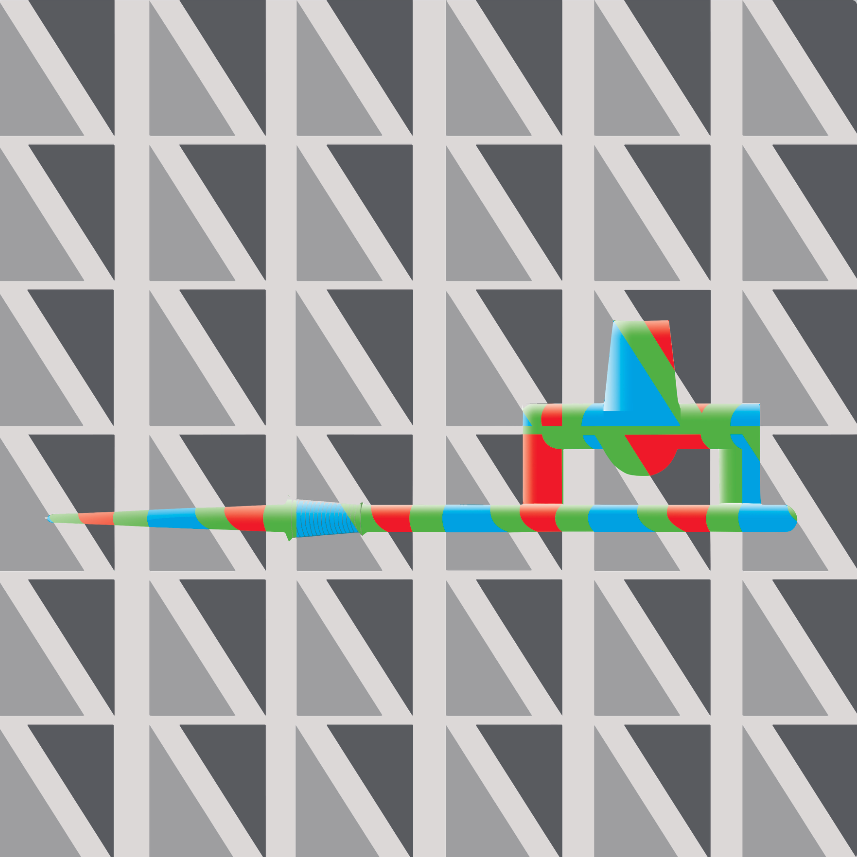
The sketch is an adaptation of Hlubi traditional skirt patterning worn by women. I have used the pattern as a compositional element in the background of the drawing to signify isiHlubi culture and identity.
Superimposed on this background pattern is a pipe. The pipe also signifies isiHlubi material culture. The choice of the pipe is deliberate to make reference to Rene Magritte’s painting whose title translated to English means ‘this is not a pipe’. The gap between representation and the physical object, or person or scene being represented is what the drawing highlights. Do the objects we see in museums suffice in informing us about their contexts?
My surname represents being umHlubi however, my upbringing is essentially umZulu. I believe this narrative relates to many other amaHlubi that carry the Hlubi names but have not been acquainted with the culture beyond that. Hence the title of the work is in isiZulu: ‘akuyona inqawe le’ this is the case simply because I wouldn’t know how to phrase this ngesiHlubi tekela.
As such, the drawing poses the question of what is being umHlubi? I hope that in the process of searching for an answer to this question the viewer to learn about amaHlubi; their cultural practices, language and history.
Share this:
CREDITS
FHYA would like to acknowledge the commitment of Iziko Museums of South Africa, Killie Campbell Africana Library of the University of KwaZulu-Natal and the KwaZulu-Natal Museum to making their holdings openly accessible and the generosity of their staff in making this presentation possible. Presentation prepared by FHYA in 2023, using materials collected by Steven Kotze in partnership with Lailah Hisham (Iziko), Senzosenkosi Mkhize (Killie Campbell Africana Library of the University of KwaZulu-Natal), Justine Wintjes and Dimakatso Tlhoaele (KwaZulu-Natal Museum), Zukisa Madyibi (Walter Sisulu University), Thozama April and Sinazo Mtshemla (University of Fort Hare) and Robert Hart (Duggan-Cronin Gallery, McGregor Museum). Archival curation prepared by Benathi Marufu with assistance from Debra Pryor. Visual curation, page design, and development by Vanessa Chen with assistance from Makhosi Mkhize and Studio de Greef. Technical support provided by Hussein Suleman. Written content produced by Steven Kotze and Carolyn Hamilton, drawing on, amongst other things, recent research by John Wright and Carolyn Hamilton. Editorial and conceptual support by Carolyn Hamilton. The FHYA is especially grateful for the ongoing research support of Muziwandile Hadebe and the KwaZulu-Natal Provincial Archives, and would further like to thank Mwelela Cele, Patricia Davison, Nessa Leibhammer, John Wright and Gavin Whitelaw for their assistance and advice during the preparation of this curation. Our presentations are archived here. If you wish to make a contribution, use this link.
EMANDULO
EMANDULO is an experimental digital platform, in ongoing development, for engaging with resources pertinent to southern African history before colonialism across what is today eSwatini, KwaZulu-Natal, Lesotho, and the Eastern Cape.