Imvo Zabantsundu, 1884-1955

Imvo Zabantsundu, 1884-1955

Scope and Content

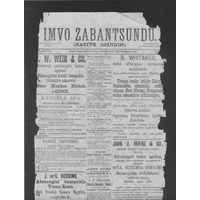
[Source - Steven Kotze, for FHYA, 2026: Established in 1884 in Qonce (King William's Town) in the Eastern Cape, Imvo Zabantsundu was the first independent Black newspaper, and one of the earliest avenues for African political and cultural expression in print. It was more than a source of news. As the country's first black-owned and -edited publication, it gave voice to African intellectuals during an era when colonial print culture dominated the public sphere. It not only covered politics but also created a record of everyday concerns, including language use, sports, and social change. Its creation marked a decisive shift from missionary-controlled indigenous language print culture to genuinely African editorial control and voice. Though the paper ceased publication in the mid-20th century, its significance as a cultural artefact endures. The founding editor, John Tengo Jabavu (1859-1921), was a teacher, preacher, and political activist committed to advancing the rights and education of Black South Africans. Before establishing Imvo Zabantsundu, Jabavu had edited Isigidimi samaXosa, an isiXhosa language newspaper published from the 1870s, but he broke away from it due to missionary reluctance to engage in explicit political debate and his desire to create a more overtly independent political platform. Imvo Zabantsundu was published weekly in both isiXhosa and English, though isiXhosa dominated much of the content, and it became a vital forum for news, opinion, letters from readers, and political commentary that reflected African concerns. It fostered political and social debate and built a readership that extended beyond King William's Town to broader regions of the Eastern Cape and colonial Natal. Its regular distribution and engagement with issues of colonial policy, education, land, and civic rights helped shape emerging Black political consciousness in the late 19th and early 20th centuries. Despite being an independent Black newspaper, Imvo Zabantsundu's financial backing came partly from sympathetic Cape liberals, such as Richard W. Rose Innes and local merchant James Weir. This support was a double-edged sword; while it enabled the paper's establishment and survival, it drew criticism from some who saw it as at times compromising the newspaper's editorial independence and its alignment with African interests. The paper's editorial leadership remained connected to the Jabavu family for decades. After John Tengo Jabavu's death in 1921, his sons, including Davidson Don Tengo Jabavu and Alexander Macaulay Jabavu, continued their father's endeavours until 1941 when Imvo Zabantsundu was sold to Bantu Press. There were interruptions in publication, including a ban from August 1901 to October 1902 during the South African War, when many publications faced censorship. The FHYA curation of Imvo Zabantsundu, 1884-1955 brings together the most comprehensive set currently available of digitised copies of the newspaper, together with supplementary materials designed to enhance their searchability. The collection is organised into 'Series' arranged chronologically by year, each containing 'File' levels arranged by month. At the 'Item' level are digital copies of the newspaper sourced from the Centre for Research Libraries (CRL) website, interleaved with converted text files produced by the isiXhosa Intellectual Traditions Project (IsiXIT). Negotiations are currently underway with the Cory Library to digitise its complete microfilm holdings of Imvo Zabantsundu. The CRL copies included in this collection are therefore provisional and will be replaced in due course by the digital versions produced from the Cory Library's microfilm.

Metadata

Title

Imvo Zabantsundu, 1884-1955

Reproduction Conditions

Creative Commons License: CC BY-NC-ND https://creativecommons.org/licenses/by-nc-nd/4.0/
Events
Event Actor Event Type Event Date Event Description
Five Hundred Year Archive (FHYA) Online curation 2026-

Contents

Contributions

Attachment - added to contribution

Metadata

Login using the Log in/Register button (top-right of page) to add a contribution.
Page actions:link link to pagecode view XML metadataexplore explore from here